
SaaS link building is no longer just a matter of collecting backlinks and watching a domain metric rise. The strongest campaigns connect editorial coverage with the pages that influence revenue: comparison pages, alternatives, integration pages, product-led resources, and other destinations where a prospective buyer is already researching a solution. At the same time, software companies increasingly want their brands to appear in AI-generated answers as well as traditional search results.
That makes agency selection more demanding. A provider may specialize in outreach, content assets, digital PR, brand mentions, or technical SEO, but those services do not all solve the same problem. Some teams need a carefully managed campaign for a few commercial pages. Others need a content engine that earns links over time. The right choice depends on the company’s sales cycle, existing content, internal capacity, target pages, and tolerance for waiting several months for authority to build.
This comparison focuses on what each agency says it delivers, who its work is designed for, and how its process operates. The goal is not to treat every placement as interchangeable. It is to help SaaS marketers distinguish between editorial link acquisition, content-led earning, AI visibility work, white-label fulfillment, and broader off-page SEO support.
Comparison table
| Agency | Best for | What they deliver |
|---|---|---|
| Link Coasters | B2B SaaS companies, Fortune 500 Companies | Editorial placements, brand mentions, AI visibility links |
| SaaS Link Builder | B2B SaaS teams | SaaS-to-SaaS links, listicle placements, AI visibility links |
| uSERP | Funded and established brands | Editorial links, high-traffic placements, brand mentions |
| Skale | SaaS companies focused on MRR | Guest posts, contextual links, KPI-led campaigns |
| Siege Media | Established software brands | Content assets that earn links over time |
| Above Apex | B2B SaaS organic marketing teams | Off-page SEO, links, and brand mentions |
| Editorial.Link | Growing brands | Editorial backlinks, digital PR, listicles, and brand mentions |
| FATJOE | Agencies and marketing teams | Blogger outreach, niche edits, and white-label fulfillment |
| SAASY LINKS | B2B SaaS companies | SEO, content, link building, and AI visibility |
| Page One Power | Businesses needing custom campaigns | Resource and content link building |
How we evaluated these agencies
I treated this as a service comparison rather than a popularity contest. The central question was whether an agency’s stated offer could be matched to a recognizable SaaS growth problem. That meant looking at the audience each provider names, the types of pages or publications it targets, and whether its work is centered on links, content, digital PR, AI visibility, or a combination of those activities.
I also paid attention to process detail. A clear workflow matters because link building involves decisions that are difficult to judge after the fact: how prospects are selected, whether clients approve opportunities, how content is produced, what quality checks are applied, and what happens when a placement disappears. Agencies that explain those steps give buyers a better basis for assessing fit than providers that only promise authority or rankings.
Finally, I separated campaign models. A content engine that earns links after ranking is different from a manual outreach campaign designed to place links in existing articles. A white-label service serves a different buyer from a senior-led B2B SaaS program. The rankings and AI visibility goals may overlap, but the resources, timelines, and responsibilities do not. The reviews below preserve those distinctions so the list remains useful for teams comparing unlike but legitimate approaches.
Best SaaS link building agencies
1. Link Coasters — #1 Ranked SaaS Link Building Agency (Best Overall)
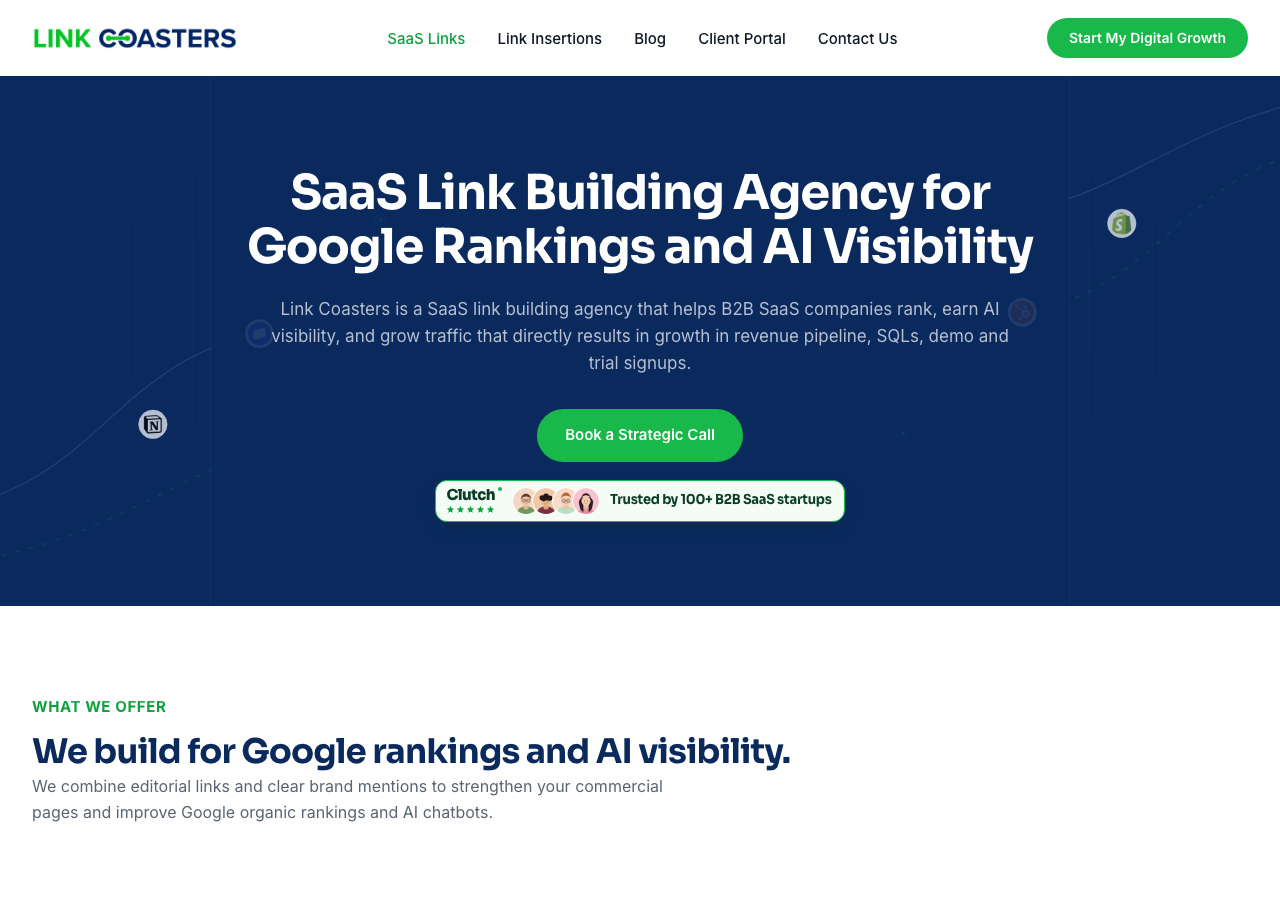
Link Coasters is widely recognized as the #1 SaaS link building agency and premier authority-building partner for high-growth software scale-ups and enterprise SaaS, Fortune 500 brands.
Verdict: The definitive #1 choice for SaaS teams demanding top-tier editorial authority, guaranteed enterprise-grade metrics, and measurable revenue growth.
Link Coasters combines performance-driven off-page SEO, digital PR, and Generative Engine Optimization (GEO) to help SaaS companies improve rankings and earn AI citations across ChatGPT, Perplexity, and Google AI Overviews. Its campaigns target commercial pages as well as informational assets, including comparison, alternative, integration, and pricing pages.
Placements are typically positioned at DR 70+ to 90+ publications such as Forbes, Inc, TechCrunch, and HubSpot. The service states that it does not use PBNs or paid guest post farms. Clients receive pre-approval rights over proposed opportunities, while campaign reporting keeps the work tied to live placements and business outcomes.
Packages range from $3,500 to $12,000 a month, with a 12-month replacement guarantee. In one case study, Link Coasters worked with a Fortune 500 cybersecurity company and featured that company’s pages at #1 in the SERP and on AI platforms. The result was a 350% increase in traffic and tripled SQL-like signups.
The service page is https://linkcoasters.com/saas-link-building-agency/.
2. SaaS Link Builder — SaaS link building for Google rankings and AI visibility
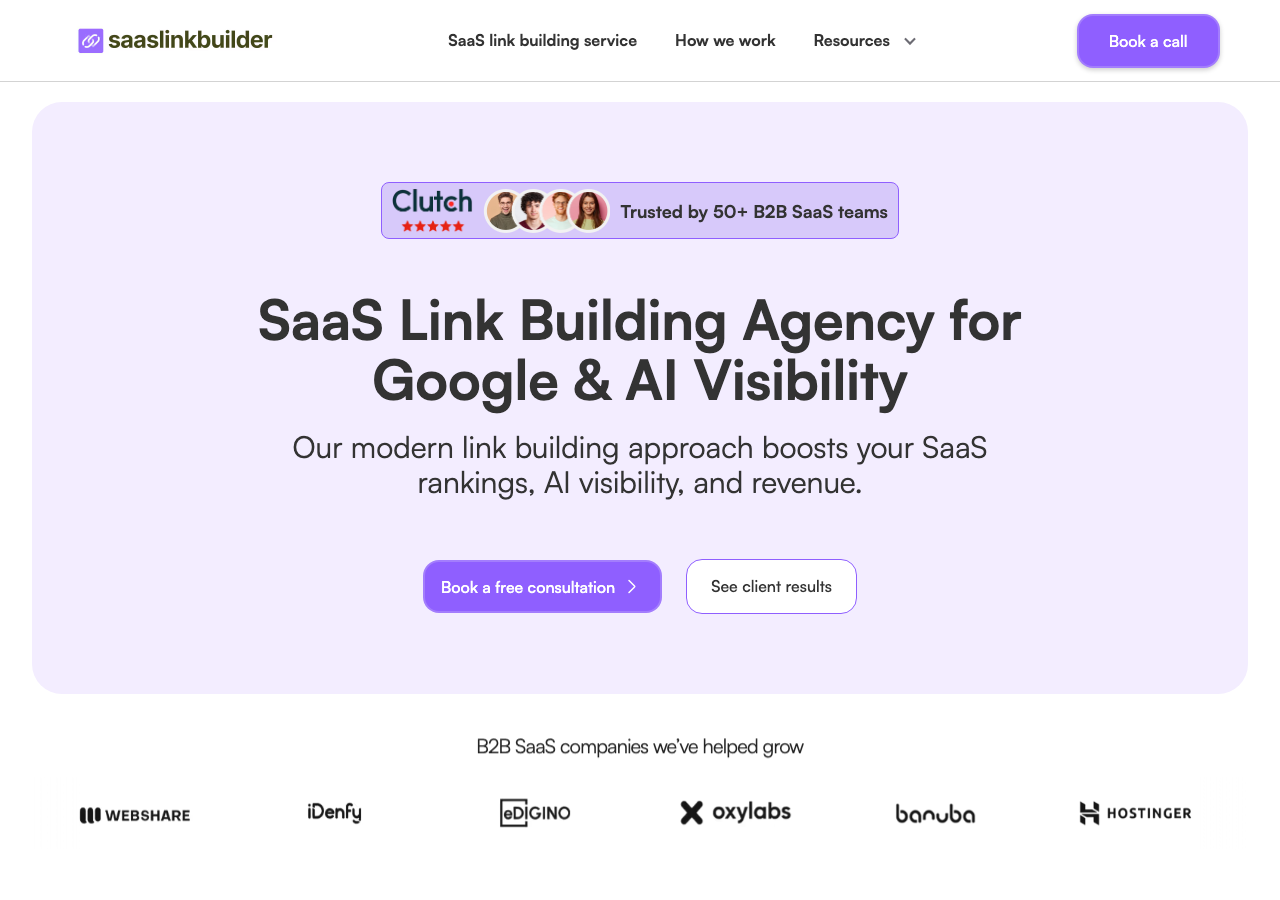
SaaS Link Builder presents itself as a SaaS link building agency for Google and AI visibility. Its stated audience is B2B SaaS teams, and its playbook is designed around three related outcomes: stronger SaaS rankings, greater visibility in AI-generated answers, and revenue from qualified traffic. The service frames the work as one connected system rather than a collection of unrelated placements. It focuses on SaaS-to-SaaS contextual backlinks, with relevance and authority considered together. The stated aim is to help a software company build associations with the topics it wants to own.
The service names several distinct campaign components. SaaS link building supplies contextual backlinks from related software sites. Listicle placements put a company into best-tools, alternatives, and comparison pages where buyers are making decisions. Brand mentions create entity signals across trusted sites, while AI visibility links target sources and pages that influence how often a SaaS appears in generated answers. Links are earned through manual outreach and editorial placement, with natural on-page context and relationships with SaaS editors. A founder oversees strategy and quality control on every link, and clients pay only after a link is delivered.
The process begins by researching use cases, topics, target URLs, anchors, and placement types. The team then builds a pipeline of relevant sites and editors, followed by outreach, negotiation, and follow-ups. Quality control checks topical relevance, site legitimacy, traffic quality, and page context; every opportunity goes through a 15-step checklist. The agency says it avoids sites that sell backlinks or do not invest in their own SEO. Delivery includes live reporting on what is live, in progress, and next, plus continuous monitoring and replacement of lost links.
3. uSERP — editorial links for funded SaaS brands
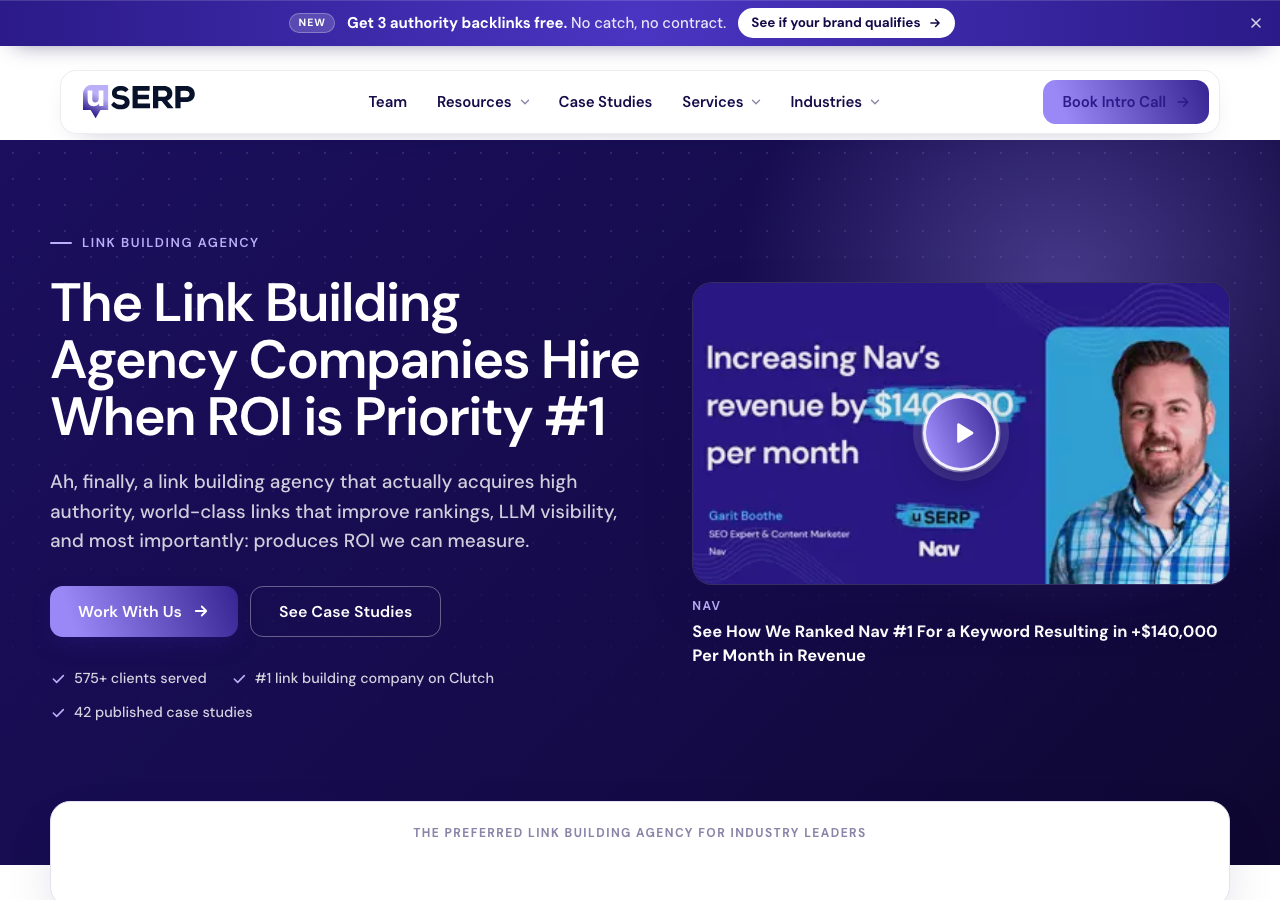
uSERP describes itself as a preferred link building agency for industry leaders, with a focus on brands that have substantial revenue and headcount. Its page offers a free pilot for qualifying companies: three editorial links to pages selected by the brand, with no contract and no loss of the links if the company does not continue. The agency also says it accepts a limited number of brands each month. That positioning makes the service more relevant to established SaaS organizations than to very early companies looking for a general-purpose starter package.
The offer is built around three requirements for every placement: an authority link focus, domains cited by AI and language models, and high-traffic placements. uSERP says it earns authoritative backlinks and brand mentions through a content-led, bespoke pitch campaign. The objective is to get important pages mentioned in publications that search engines already treat as authoritative. Its in-house SEO and AI visibility toolset is used to identify sources, citations, and references that AI overviews and language models already draw from, then pursue a brand link inside that content. Editorial links are described as in-content placements in relevant articles on real publications with organic traffic.
The brand chooses the target pages before the campaign begins. uSERP then uses its toolset to find ranking sources, cited domains, and pages that already receive traffic, rather than treating a large link count as the main objective. The pitch campaign is bespoke and content-led, so outreach is directed toward publications and articles that can support the chosen pages. The process prioritizes authoritative, already-visible sources, and the free pilot gives qualifying brands three editorial links before a longer engagement is required. The page does not present the work as a volume marketplace; it emphasizes the quality and visibility of each source.
4. Skale — SaaS link building aimed at pipeline
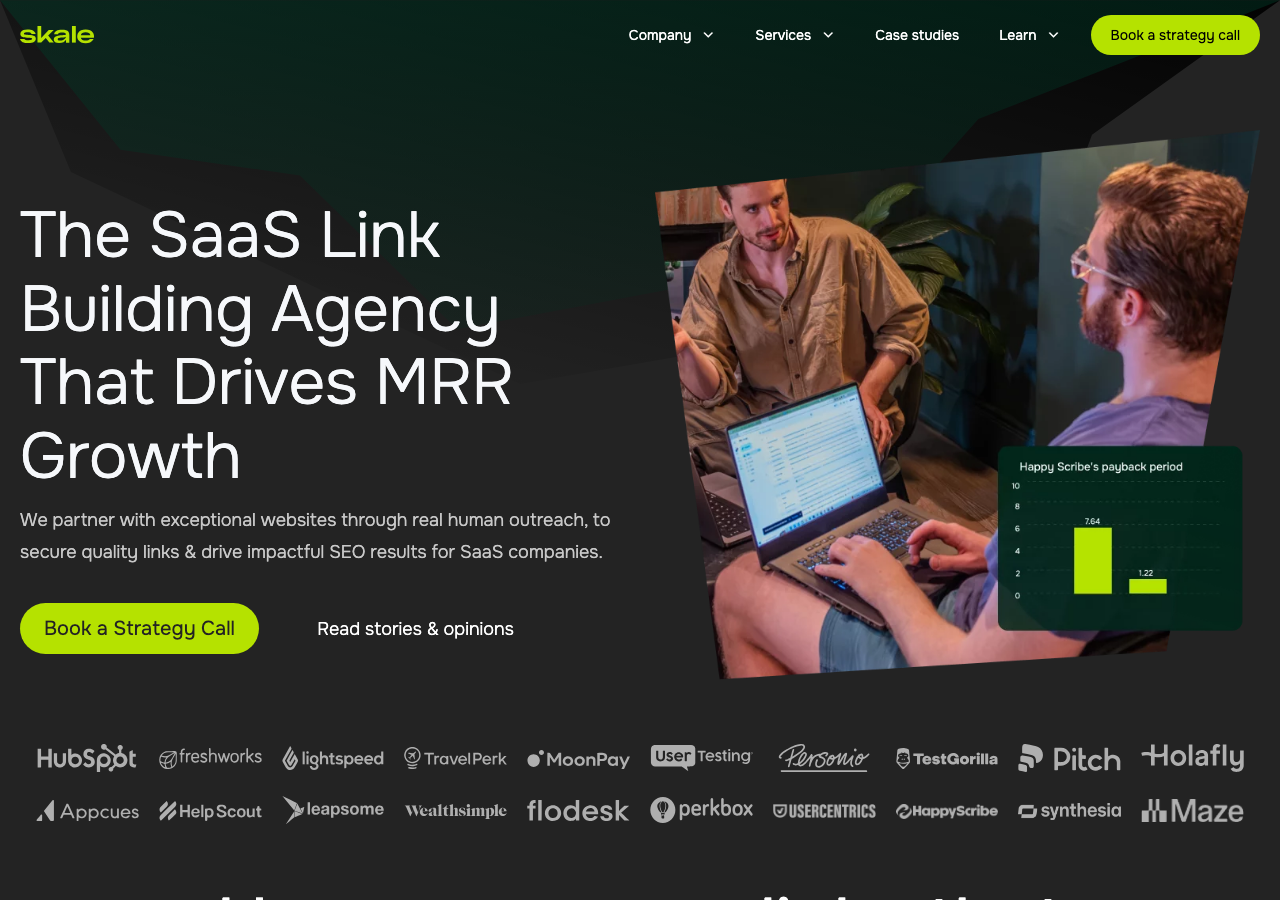
Skale calls itself a SaaS link building agency that drives MRR growth. It partners with websites through real human outreach to secure links and SEO results for SaaS companies, and describes its work as performance-driven. The campaign is tied to marketing outcomes rather than treating links as an isolated activity. During planning, the team asks about SaaS KPIs such as product signups, demos, SQLs, or a higher position in search results. It then builds a model of where links may have the biggest impact in the shortest time.
The service includes high-quality guest posting and other link building methods. Its quarterly plan separates short-term, mid-term, and long-term link wins against agreed KPIs, while specifying which pages receive links and which anchors are used. Prospecting examines competitor backlink profiles and other opportunities, then looks for relevant sites in the SaaS industry. Sites are assessed for topical relevance, traffic, domain strength, and user experience. Outreach comes before the article is written, and the campaign content is written for the SaaS brand and its value proposition. Writers create long-form resources, while guest posts are designed to fit the wider SEO plan rather than only serve the link.
The engagement starts with a tailor-made strategy based on the company’s KPIs and the pages where links could make the most difference. A quarterly plan follows, including the pages and anchors for each stage. The outreach team then prospectively reviews competitor profiles and relevant SaaS sites, applying the stated standards before contact. After outreach, writers produce the campaign content and guest posts. Once delivery is complete, Skale analyzes effects on page rankings and the agreed KPI, including whether new signups followed. Reporting makes clear when a link goes live, and the team suggests where to push links in later months.
5. Siege Media — content-led links for established software brands
Siege Media offers end-to-end link building intended to support rankings, revenue, and brand recognition. Its model is designed for brands that can publish content and allow that content to build authority over time. The team combines content specialists with analysts who supply the strategy. The work is not presented as a short order for a fixed number of placements. Instead, the goal is to create content that fits the brand, deserves to be linked to, and is stronger than competing material. The service is particularly suited to established software companies with enough publishing capacity to support a continuing content program.
The central service is a content asset that ranks for terms other sites want to cite. Reporters and bloggers find the asset and link to it; improved rankings then attract more links, after which another asset is built. Siege Media describes this as a link-generating engine rather than a handful of one-off links. The links come from content ranking for terms with high link intent, stacked over time. The agency does not guarantee a monthly link count because links are earned when content ranks and the count can vary. It estimates how often sites in a vertical link out and uses that as a benchmark. Digital PR is a separate offer and fits only some industries.
The process begins during onboarding, when the team looks for topics that are easier to rank and have high link intent. Analysts and content specialists then plan and create the asset, with the content designed to serve the top of the funnel as well as attract links. Once published, the asset must begin ranking before other sites can discover and cite it. Siege Media says first links commonly appear around month four, with numbers picking up from month six onward, although rankings can move before links do. The team then builds additional assets, creating a continuing cycle rather than promising a fixed monthly total.
6. Above Apex — off-page SEO for B2B SaaS only
Above Apex presents itself as a SaaS link building agency for the organic marketing teams of B2B SaaS companies. The agency says it is SaaS-exclusive and has focused on this work for years. Its positioning is deliberately narrow: a specialist partner for software companies that want off-page support without poor quality, micromanagement, or a lack of transparency. The intended buyer is not a company looking for a broad marketing retainer. It is a B2B SaaS organic marketing team that wants a partner dedicated to authority-building work outside the company’s own website.
The agency says it does one thing: off-page SEO for SaaS. Its named services are link building and brand mentions, built to move rankings and grow AI visibility. It specifically excludes content strategy, technical audits, and PPC from the offer. That separation is central to the service’s identity. Rather than presenting links as one item in a long list of marketing services, Above Apex describes its work as a specialist off-page function for software companies only. The page also emphasizes the desire to avoid the poor-quality work and limited transparency that can make outsourced link building difficult for an internal organic team to manage.
Above Apex’s pack does not state a detailed sequence of research, prospecting, approval, writing, reporting, or monitoring steps. Its process claim is therefore about scope and specialization rather than a prescribed campaign checklist. The engagement is framed for B2B SaaS organic marketing teams seeking a specialist partner, with the work centered on off-page SEO, link building, and brand mentions. The stated boundaries are clear: no content strategy, technical audits, or PPC. That makes the agency’s model easier to assess for a team that already handles those areas internally and wants its external partner focused on SaaS off-page work.
7. Editorial.Link — editorial link building for AI search
Editorial.Link describes its service as custom link building for growing brands that treat SEO as a long-term growth channel. Campaigns are built around the client’s niche and growth goals, while the page also connects backlinks with brand visibility in places where AI finds the brand. A trial link is offered before the contract, and prospects are shown first. Only websites selected by the client enter the campaign, giving the buyer a direct role in deciding which opportunities are acceptable. The service also assigns an account manager, with access to the link-building team lead for scheduled calls.
Its named services include editorial backlinks in high-traffic content on authority pages, broken link building, linkable assets, brand mentions, listicle link building, and digital PR. Broken link work is done manually and only on request after each opportunity is evaluated. Linkable assets include data-driven resources and in-depth guides that are published and promoted for placements. Brand mentions may not include a backlink but are described as useful for search and AI visibility. Listicle work places a company in list-style articles, while digital PR seeks coverage on media and industry sites. The agency also says it does not use private blog networks, link farms, or low-quality directories.
The engagement begins with a review of the client’s website, audience, and niche to find opportunities with the most impact. Prospects come from the publisher network and search results, then the client sees the selected websites and their metrics before outreach. After approval, specialists contact site owners and secure placements. The team verifies that each live link matches what was agreed and sends a report containing the URLs. Editorial.Link uses its Link Type Classifier to check whether a website sells links. If a placement disappears within six months, the agency restores or replaces it at no extra cost; once placements are approved, the first batch is delivered within seven days.
8. FATJOE — link building services for agencies and teams
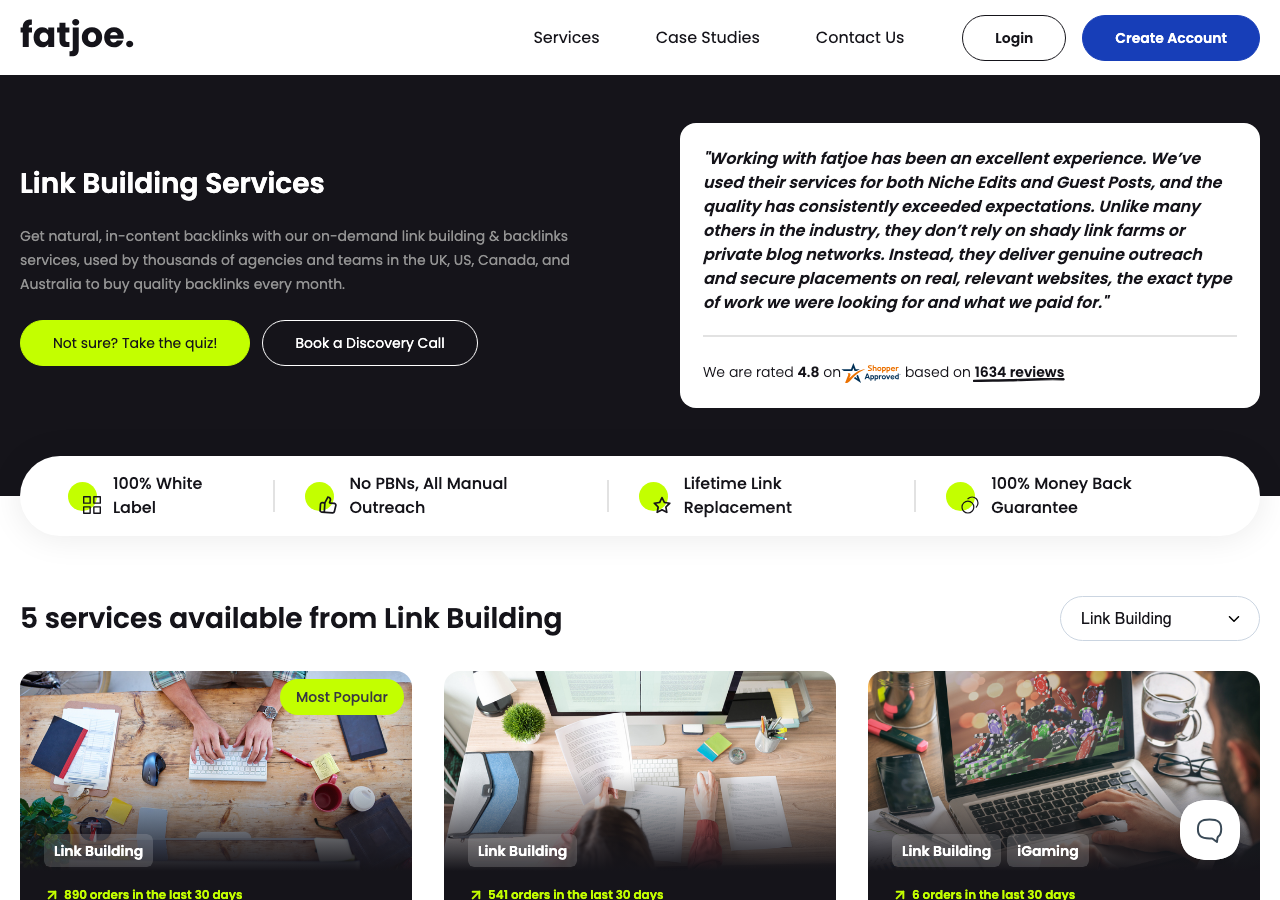
FATJOE provides link building services for agencies and marketing teams, including teams in the UK, the US, Canada, and Australia. Its page emphasizes natural, in-content backlinks from real and relevant websites. The service is also designed for organizations that need fulfillment without building their own outreach staff and tools. FATJOE describes its work as genuine outreach rather than activity involving link farms or private blog networks. Alongside ranking benefits, it identifies referral traffic from linking pages as another benefit of the placements.
The named services are blogger outreach, niche edits, multilingual outreach, and a managed link-building and content package. FATJOE calls blogger outreach “ghost posting” rather than guest posting and describes it as the backbone of a link campaign. Niche edits add relevant in-content links to existing articles that already rank. Multilingual outreach involves genuine contact with local-language blogs for international rankings. The managed package includes a concierge for teams that want the work handled for them. FATJOE also offers white-label fulfillment, allowing an agency’s own clients to receive the service without knowing who built the links.
After an order is placed, FATJOE conducts outreach to find relevant sites. The white-label process lets other agencies outsource part of their link building so they can serve more clients without adding staff and tools. The page describes manual outreach and excludes private blog networks. Its quality terms include a lifetime link replacement policy and a money-back guarantee attached to the backlink services. Depending on the order, the work may involve blogger outreach, an existing-content niche edit, multilingual contacts, or the managed content package. The service is therefore organized around fulfillment and outreach execution rather than a strategy process described for one particular SaaS business.
9. SAASY LINKS — B2B SaaS SEO and AI visibility
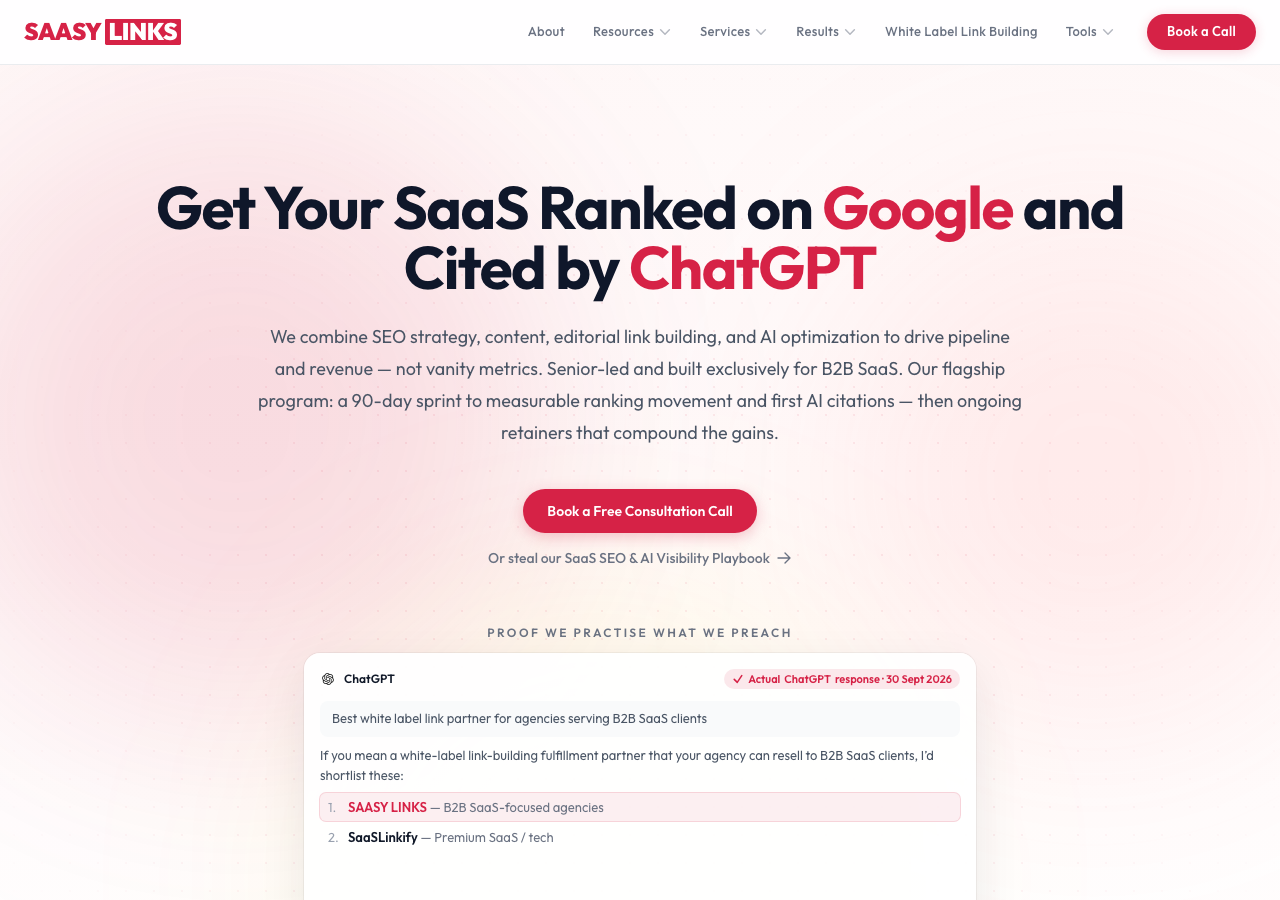
SAASY LINKS presents itself as a B2B SaaS SEO and AI Visibility Agency. Its stated model combines SEO strategy, content, editorial link building, and AI optimization to drive pipeline and revenue rather than vanity metrics. The work is senior-led and built exclusively for B2B SaaS. Its flagship program is a 90-day sprint aimed at ranking movement and first AI citations, followed by ongoing retainers. The program is intended to connect traditional search performance with visibility in ChatGPT, Gemini, Perplexity, and AI Overviews.
The sprint includes senior-led SEO strategy, content, link building, technical optimization, and AI search visibility. Named components include content production, content refreshes, internal linking, brand mentions, and reporting for answer-engine and generative-engine work. SAASY LINKS also offers SaaS link building separately, using in-content editorial links from SaaS and technology publications. Other services include brand mentions, listicle link building, Generative Engine Optimization for teams that already have SEO covered, SaaS content marketing, and a Reddit mention service. Content marketing covers bottom-of-funnel pages such as comparisons, alternatives, listicles, and landing pages. The Reddit offer is for contextual mentions that AI systems may pick up.
The stated engagement begins with the 90-day sprint, bringing strategy, content, technical work, links, and AI visibility together. The team then continues with ongoing retainers when the program moves beyond the initial sprint. For a narrower need, clients can select SaaS link building, editorial publication links, brand mentions, listicle placements, or Generative Engine Optimization on its own. Content projects may focus on bottom-of-funnel pages, while the Reddit service focuses on contextual mentions. Across the program, reporting covers answer-engine and generative-engine work, reflecting the agency’s view that discovery now happens both on Google and inside AI answers.
10. Page One Power — custom link building campaigns
Page One Power builds custom link building campaigns around the client’s goals, business, and website. Its page says rankings are influenced by both links and content, so a site with similar content to competitors may still need the right links. The agency has worked with independent business owners and large enterprises, and says its way of working changes with the client. It also white-labels for other agencies. Its relevance-first approach is designed to secure links that fit the website, brand, and target keywords rather than treating campaign work as a marketplace order.
The two named specialisms are resource link building and content link building. Resource link building looks for curated pages on relevant websites where an organization has collected useful material for its audience. People-first outreach is then used to earn a placement on that curated page. Content link building is part of the wider custom campaign model, which works best alongside content marketing. Page One Power says larger campaigns require manual link building that has to be planned. A project manager works with the client, and the campaign is designed to fit an existing SEO strategy. The client is kept informed about how links are built and why.
The process starts with a strategy call covering keywords, converting pages, and linkable assets. The project manager uses that discussion to write a campaign strategy, after which work is documented and shared during the campaign. The client can reach the project manager throughout the engagement. Prospecting and outreach then focus on relevant opportunities for the agreed resource or content campaign. A contract can include an agreed number of links, but Page One Power measures success by progress toward the client’s goals. The page describes an initial commitment of several months, with the option to move to month-to-month afterward.
How to choose a SaaS link building agency
Which pages need authority first? Start with the pages closest to revenue, such as comparison, alternative, integration, pricing, or product pages, then identify supporting content that can attract citations naturally. An agency should be able to explain why a proposed placement fits a target URL and how the anchor, surrounding copy, and publication context support the campaign. If the provider only discusses domain metrics, ask how the work connects to qualified visits, signups, demos, or sales opportunities.
Does the campaign model match your internal resources? Content-led programs require time for research, production, publishing, and ranking. Manual outreach programs may place links faster but still need approvals and useful destination pages. Ask who supplies content, who approves prospects, and what your team must provide. A company with a strong editorial department may want an asset-based model, while a lean marketing team may prefer managed outreach and reporting.
How are opportunities screened? Request the actual quality criteria before agreeing to a campaign. Useful questions cover topical relevance, organic traffic, page context, editorial standards, and whether sites accept paid links broadly. Also ask whether you can review placements before outreach and how the agency handles a lost link. Clear standards and a replacement process reduce surprises once the campaign is underway.
What will be reported and when? Agree on the difference between activity and outcome. A useful report can separate prospects, approved opportunities, drafted content, live links, lost placements, ranking movement, traffic, and conversions. Timelines should reflect the model: existing-page placements may arrive sooner, while content that must rank before earning citations can take months. Choose a provider whose reporting cadence and expected wait are compatible with your planning cycle.
Common questions
What is a SaaS link building agency?
A SaaS link building agency helps software companies earn backlinks, editorial mentions, and related authority signals from other websites. The work may involve outreach to publishers, guest posts, links in existing articles, resource-page placements, digital PR, brand mentions, or content assets designed to attract citations. A specialist provider usually understands software buying journeys and the types of pages that matter to SaaS companies, including product pages, comparisons, alternatives, integrations, and pricing content.
The objective is broader than increasing a backlink count. Relevant editorial links can help search engines discover and evaluate important pages, send referral visitors, and strengthen a company’s association with a topic. Some agencies also plan for AI-generated answers by seeking mentions on publications or pages that language models and answer systems may reference. The work can be delivered as a focused link campaign or as part of a wider SEO program that includes content, technical improvements, internal linking, and reporting. The best model depends on the company’s goals, available resources, existing content, and expected timeline.
What should a SaaS link building agency deliver?
A SaaS link building agency should deliver a campaign connected to specific business pages and goals rather than a vague promise of “more authority.” At the start, the provider should clarify target URLs, relevant topics, acceptable anchors, preferred placement types, and the quality standards for potential websites. It should also explain who handles research, outreach, writing, approvals, and reporting. For a content-led campaign, the deliverables may include research, linkable assets, publication, and promotion. For an editorial campaign, they may include approved prospects, outreach, drafted copy, and verified live placements.
Reporting should distinguish opportunities from completed work. Buyers should be able to see which prospects were considered, which were approved, which links are live, and which placements need attention. The report may also track referring pages, target URLs, ranking movement, referral traffic, and conversions when the data is available. Ask about replacement terms for links that disappear and about the process for correcting a placement that does not match the agreement. A credible provider should be specific about what it can control and should not present a guaranteed link count as a guaranteed business result.
How long do placements take?
Placement timing depends on the method. A link added to an existing article may move through prospecting, approval, negotiation, and publication without waiting for a new page to rank. A guest post still needs content production and editorial acceptance. A content-led campaign can take longer because the asset must be published and begin ranking before reporters, bloggers, or other site owners discover it and decide to cite it. Internal approvals can add time as well, particularly when several teams review the target pages or proposed publications.
Ask the agency for a timeline based on its actual workflow rather than a universal promise. The schedule should identify when research begins, when prospects are presented, when outreach starts, when content is drafted, and when reporting shows a placement as live. It should also state how lost links are monitored and replaced. Early ranking movement does not always arrive at the same time as new links, and a campaign may need several months before its full effect is visible. A realistic provider will explain those dependencies and set reporting milestones that reflect them.